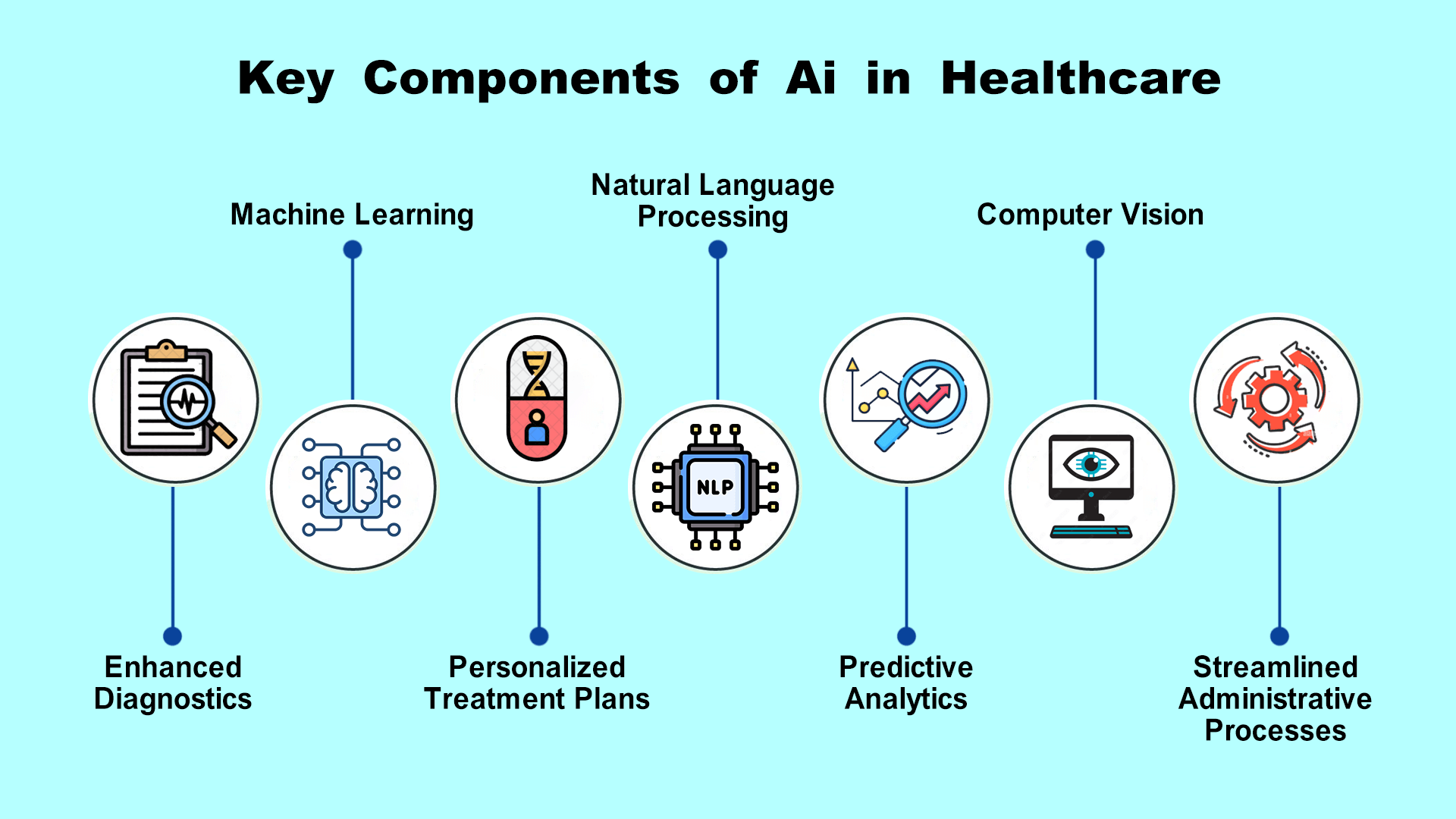
AI is a group of technologies that enable machines to perform tasks that typically rely on human intelligence, such as learning, solving problems, and making decisions. Central to the power of AI in healthcare are algorithms that analyze and process text, images, audio, and video to detect patterns and connections.
Types of algorithms include :
| Pros | Cons |
|---|---|
| Enhanced diagnostic accuracy | Data privacy and security risks |
| Advanced data management | Bias and fairness concerns |
| Personalized treatment plans | Emerging regulatory and legal challenges |
| Accelerated drug discovery | Interoperability issues |
| Enhanced predictive analytics | Reliability and accountability concerns |
| Better accessibility for patients | Resistance to adoption |
| Increased surgical accuracy | High costs |
AI would propose a new support system to assist practical decision-making tools for healthcare providers. In recent years, healthcare institutions have provided a greater leveraging capacity of utilizing automation-enabled technologies to boost workflow effectiveness and reduce costs while promoting patient safety, accuracy, and efficiency . By introducing advanced technologies like NLP, ML, and data analytics, AI can significantly provide real-time, accurate, and up-to-date information for practitioners at the hospital. According to the McKinsey Global Institute, ML and AI in the pharmaceutical sector have the potential to contribute approximately $100 billion annually to the US healthcare system . Researchers claim that these technologies enhance decision-making, maximize creativity, increase the effectiveness of research and clinical trials, and produce new tools that benefit healthcare providers, patients, insurers, and regulators . AI enables quick and comprehensive retrieval of drug-related information from different resources through its ability to analyze the current medical literature, drug databases, and clinical guidelines to provide accurate and evidence-based decisions for healthcare providers. Using automated response systems, AI-powered virtual assistants can handle common questions and provide detailed medical information to healthcare providers . AI-powered chatbots help reduce the workload on healthcare providers, allowing them to focus on more complicated cases that require their expertise. Also, AI algorithms can generate specific recommendations for individual patients, considering factors like health conditions, past medical and medication history, and social/lifestyle preferences, allowing healthcare professionals to optimize medication choices and dosages .
Population health management increasingly uses predictive analytics to identify and guide health initiatives. In data analytics, predictive analytics is a discipline that significantly utilizes modeling, data mining, AI, and ML. In order to anticipate the future, it analyzes historical and current data. ML algorithms and other technologies are used to analyze data and develop predictive models to improve patient outcomes and reduce costs. One area where predictive analytics can be instrumental is in identifying patients at risk of developing chronic diseases such as endocrine or cardiac diseases. By analyzing data such as medical history, demographics, and lifestyle factors, predictive models can identify patients at higher risk of developing these conditions and target interventions to prevent or treat them . Predicting hospital readmissions is another area where predictive analytics can be applied. By analyzing patient demographics, medical history, and social health factors, predictive models can identify patients at higher risk of hospital readmissions and target interventions to prevent readmissions ; this can help reduce healthcare costs and improve patient outcomes which is the reason behind launching new companies such as “Reveal ".